
The 35mm Film Revival: How to Retrieve a Rewound Film Leader
How Fujifilm X half Is Bringing Film-Inspired Photography Back Into Focus
Taking photos has never been easier. A smartphone can capture dozens of images in seconds, adjust them automatically, and share them almost instantly. Yet in a world built around speed and immediate results, more photographers are becoming interested in the slower pace, physical controls, and unpredictability associated with film photography.
The growing interest in the Fujifilm X half reflects this shift.
To be clear, the Fujifilm X half is a digital camera and does not use 35mm film. However, it draws inspiration from classic half-frame film cameras and recreates parts of the analog experience through its default vertical format, 2-in-1 images, Film Simulations, Frame Advance Lever, and Film Camera Mode.
In Film Camera Mode, photographers select a Film Simulation or filter and choose the number of images in their virtual roll. Instead of constantly reviewing and deleting photos, they complete the roll before digitally “developing” the images through the X half app.
The process encourages a more deliberate rhythm: compose the image, press the shutter, pull the Frame Advance Lever, and look for the next photograph.
Although the X half is not a film camera, it is helping introduce more photographers to half-frame composition, film-inspired color, and analog camera culture. Some users may be perfectly happy creating film-style images digitally. Others may become curious about shooting real 35mm film.
That renewed interest can also be seen in the traditional film camera market. Ricoh introduced the PENTAX 17, a new half-frame camera that captures two images within the area normally used for one standard 35mm frame. Lomography has also introduced new models such as the Lomo MC-A 35mm Film Camera, combining physical film with features such as autofocus and automatic exposure.
From digital cameras that recreate the analog experience to newly released cameras that use physical film, photographers are rediscovering what makes 35mm photography so engaging.
Once you start shooting real film, however, you also encounter a few problems that do not exist with digital cameras. One of the most common is surprisingly simple:
What should you do when the film leader disappears completely inside the cassette?
What Is a 35mm Film Leader?
The film leader is the narrow, tapered section at the beginning of a roll of 35mm film.
When loading a camera, you pull the leader out of the cassette and insert or attach it to the camera’s take-up spool. Each time you advance the film, the take-up spool moves a fresh section of film behind the camera’s film gate.
After the roll has been exposed, the film must be rewound into its light-resistant cassette. Many electronic cameras rewind automatically, while manual cameras usually require the photographer to turn a rewind crank.
Fully rewinding an exposed roll normally helps protect the images. A film lab can open the cassette under controlled darkroom conditions.
A hidden leader becomes a problem only when you still need access to it.
Common situations include:
Accidentally rewinding an unused roll
Rewinding a roll before all the frames have been exposed
Changing film stocks in the middle of a roll
Reloading a partially exposed roll later
Preparing a roll for home development
Testing the film advance and rewind functions of a vintage camera
Rerolling or bulk-loading 35mm film
In these situations, the film may still be perfectly usable. The leader is simply trapped inside the cassette where it cannot be reached by hand.
Why Does the Film Leader Disappear Into the Cassette?
Automatic Rewind
Many electronic 35mm cameras automatically rewind the film after the last exposure. Unless the camera has a setting that intentionally leaves the leader out, it will usually disappear inside the cassette.
Rewinding Too Far by Hand
With a manual camera, the photographer may continue turning the rewind crank after the film has released from the take-up spool. This pulls the entire leader into the cassette.
Accidental Rewind
The rewind button may be pressed unintentionally, or the photographer may begin rewinding before realizing that several frames remain unused.
Changing Film Mid-Roll
Some photographers switch films as lighting conditions change. For example, they may replace a slow daylight film with a faster film for an indoor setting. If the first roll is fully rewound, its leader must be retrieved before the roll can be loaded again.
When reloading partially exposed film, record the number of the last frame used. After reloading, cover the lens and advance the film several frames beyond that number. This helps reduce the risk of overlapping the previous exposures.
Common Ways to Retrieve a 35mm Film Leader
Method 1: Open the Cassette
A cassette opener can be used to remove the end cap and access the film. However, this must be done in complete darkness or inside a properly closed changing bag.
Opening a loaded cassette in normal light can expose the film and damage the images. The process may also bend or permanently damage the cassette, preventing it from being reused.
This method is more appropriate when the film is ready for processing and does not need to remain inside its original cassette.
Method 2: Use Double-Sided Tape
Some photographers attach double-sided tape to a separate strip of film, insert it into the cassette, and try to stick it to the hidden leader.
This method may work, but positioning the tape can be difficult. The adhesive may leave residue, attach to the wrong part of the film, or require repeated attempts.
Method 3: Use a Wet Strip of Film
Another traditional method involves slightly moistening a scrap piece of film, inserting it through the cassette opening, and trying to make it adhere to the hidden leader.
Although this method can work, it introduces moisture near the film and cassette. Results can also be inconsistent, particularly for beginners. Repeated attempts may create additional contact with the film.
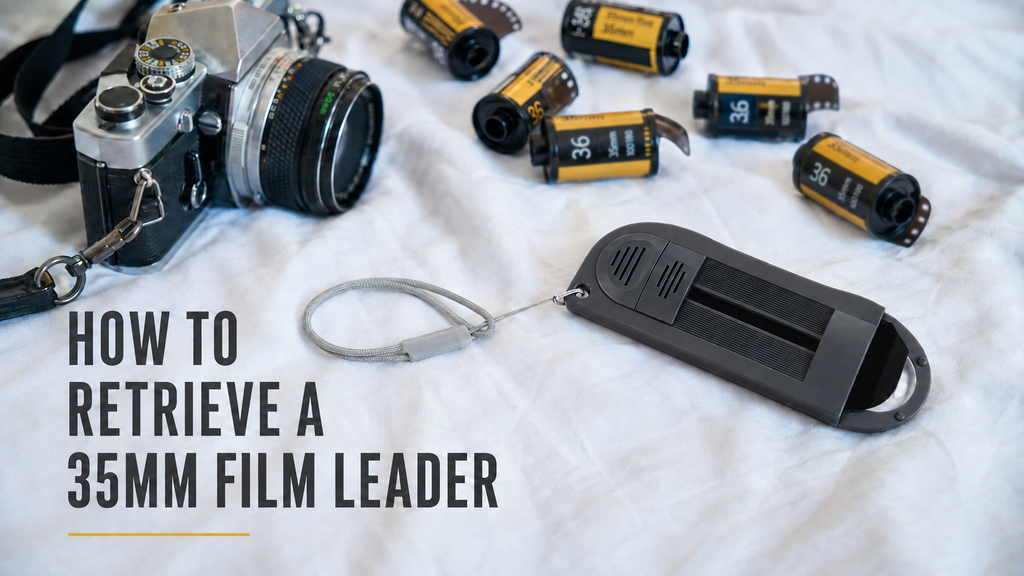
Method 4: Use a Dedicated 35mm Film Retriever
A dedicated film retriever is designed specifically to solve this problem.
Its thin blades enter through the cassette’s felt-lined opening. By moving the sliders in sequence and rotating the cassette spool, the tool can engage the hidden leader and pull it back out.
A dedicated retriever does not require you to:
Open or damage the cassette
Use tape or adhesive
Introduce moisture near the film
Use batteries or electricity
Prepare disposable materials
Once you understand the process, the same tool can be used repeatedly.
How to Retrieve a Rewound 35mm Film Leader

Step 1: Check the Film and Reset the Sliders
Confirm whether the film is unused, partially exposed, or fully exposed. Label the cassette if necessary to avoid mistaking exposed film for a fresh roll.
Move both control sliders back to their starting positions so the internal blades are fully retracted. Do not bend or pull the blades by hand.
Step 2: Insert the Retriever
Hold the film cassette securely and carefully insert the retriever blades into the felt-lined opening.
Push the blades in until the tool reaches its normal stopping point. Keep the retriever level and do not force it against the cassette.
Step 3: Move the First Slider
Push the first textured slider forward to extend the first movable blade inside the cassette.
Keep the retriever aligned with the cassette opening throughout the process.
Step 4: Rotate the Film Spool
Slowly rotate the cassette’s center spool counterclockwise, or in the direction specified by the retriever instructions.
Listen for a faint click or feel for a slight change in resistance as the hidden film leader passes the first blade.
Step 5: Move the Second Slider
After hearing or feeling the click, push the second slider forward.
The second blade helps grip and capture the film leader inside the retriever.
Step 6: Pull Out the Film Leader
Keep both sliders in position and pull the retriever straight out using a smooth, controlled motion. The captured film leader should come out with the tool.
If it does not work, reset both sliders before trying again. Do not twist or jerk the retriever. Stop if the film feels jammed, appears torn, or cannot be retrieved after several careful attempts. A damaged roll may need assistance from a film lab.
Important Film-Handling Precautions
The original leader was normally exposed to light when the film was first loaded, so retrieving that section can generally be done in normal indoor lighting.
However, pull out only the amount of leader you need. Do not continue pulling the image-bearing portion of the film from the cassette.
Keep these precautions in mind:
Work away from direct sunlight.
Do not open a loaded cassette in normal light.
Do not use a knife, needle, or other sharp metal object.
Do not force the film if it feels stuck.
Keep the retriever blades clean.
Prevent dust, sand, and grit from contacting the film.
Avoid touching the image area.
Label exposed and partially exposed rolls immediately.
When reloading a partially exposed roll, advance beyond the previously used frames before continuing.
Half-frame photographers should pay particular attention to the actual number of images taken. According to the official PENTAX 17 product information, a 36-exposure roll can produce approximately 72 half-frame photographs.
Accurate frame records are therefore especially important when unloading and reloading partially exposed half-frame film.
Why Regular Film Shooters Benefit From a Dedicated Retriever
Tape and wet-film methods may work in an emergency, but they are not always practical for photographers who regularly shoot film.
A dedicated retriever provides a clearer and more repeatable process. It requires no extra materials and allows the cassette to remain intact.
It is particularly useful for:
Photographers who change film mid-roll
Half-frame film camera users
Home film developers
Film labs and photography studios
Photographers testing vintage cameras
Users who reroll or bulk-load 35mm film
Beginners learning the complete analog workflow
Photographers who carry several film stocks on location
A film retriever may be one of the smallest accessories in your camera bag, but it becomes extremely useful when a leader unexpectedly disappears.
A Reliable Film Retriever for Your 35mm Photography Kit
To help film photographers handle fully rewound leaders more conveniently, our 35mm Film Retriever/Extractor with Strap features a simple, durable, and reusable design.
It is more than a temporary emergency solution. It can become a regular part of a film photography bag, home development kit, or professional studio toolbox.
Three Smooth, Polished Blades
The tool uses three polished blades to enter the 35mm cassette and engage the hidden film leader.
Compared with rough improvised materials, the smooth blades make gentler contact with the film and help reduce unnecessary friction and the risk of scratches.
No film-handling tool should promise that scratches are impossible. Results also depend on the user’s technique, the condition of the film, and whether the cassette opening has been bent. However, purpose-built polished blades provide a more suitable contact surface than many improvised alternatives.
Durable ABS Construction
The retriever body is made from durable ABS material that resists wear and deformation during regular use.
Tape and wet-film methods are usually temporary. A reusable ABS film retriever can be stored in your kit and used whenever another leader needs to be recovered.

Textured Dual Sliders
Two independent sliders on the top of the tool control the internal blades. Both feature textured surfaces that make them easier to move with a fingertip.
The sliders allow the user to insert, position, and capture the leader in separate stages.
This straightforward design is practical for experienced film photographers while remaining approachable for beginners after a little practice.

Compact Design With No Extra Supplies
The retriever does not require:
Batteries
Electricity
Tape
Adhesive
Water or other liquids
Disposable accessories
Its compact body fits easily into a camera bag, film case, processing kit, desk drawer, or darkroom toolbox.
Convenient Carrying Strap
Small photography accessories can easily disappear at the bottom of a camera bag or get misplaced during a shoot.
The included strap makes the retriever easier to carry, hang, locate, and secure. It also provides a convenient way to organize the tool in a studio or darkroom.

Useful for Beginners and Experienced Film Photographers
The retriever has no complicated electronic components. Once users understand the slider sequence and learn to recognize the faint sound of the leader passing the blade, the tool can be used repeatedly.
It is useful for beginners who were introduced to analog aesthetics through cameras such as the Fujifilm X half and now want to try real 35mm film. It is equally practical for experienced photographers who regularly process, reroll, or reload film.
Dedicated Film Retriever vs. Common Alternatives

A dedicated film retriever does not replace careful handling, and it should not be advertised as guaranteeing a completely scratch-free result. Its primary advantage is that it offers a purpose-built, controlled, and reusable solution.
About Foto&Tech
Foto&Tech offers practical photography accessories designed to make everyday shooting, equipment care, and camera organization more convenient. From film photography tools to lens accessories and other camera essentials, our products focus on useful functions, straightforward operation, and dependable materials.
Whether you are exploring 35mm film for the first time or have years of photography experience, Foto&Tech helps you build a more prepared and organized camera kit—so you can spend less time dealing with small equipment problems and more time creating photographs.

Frequently Asked Questions
Does the Fujifilm X half Need a 35mm Film Retriever?
No.
The Fujifilm X half is a digital camera that uses an image sensor and memory card. It does not load physical 35mm film, so it cannot experience a film leader disappearing into a cassette.
The X half is discussed here because its film-inspired design is introducing more photographers to analog photography—not because this film retriever is an accessory for the camera.
Is a Roll Ruined if the Leader Is Fully Rewound?
Usually not. As long as the cassette has not been opened in normal light, the film inside should remain protected.
Can I Retrieve the Leader in Daylight?
You can generally retrieve the original leader in normal indoor lighting. Avoid direct sunlight and do not pull the image-bearing portion of the film out of the cassette.
Do I Need to Retrieve the Leader Before Processing?
Not always. Many labs open the cassette in darkness as part of the normal development process. Ask your lab whether it prefers the leader inside or outside the cassette.
Can I Reload the Film After Retrieving the Leader?
Yes, provided the film and cassette are undamaged.
If the roll is partially exposed, record the last frame used. After reloading, cover the lens and advance the film several frames beyond that number before continuing to shoot.
Can This Retriever Be Used With 120 Film?
No. The tool is designed for standard 35mm film cassettes. Medium-format 120 film uses a paper-backed roll and spool system rather than the same type of cassette.