Does the Fujifilm X100VI Need a Lens Hood? Benefits, Protection, and 49mm Filter Use
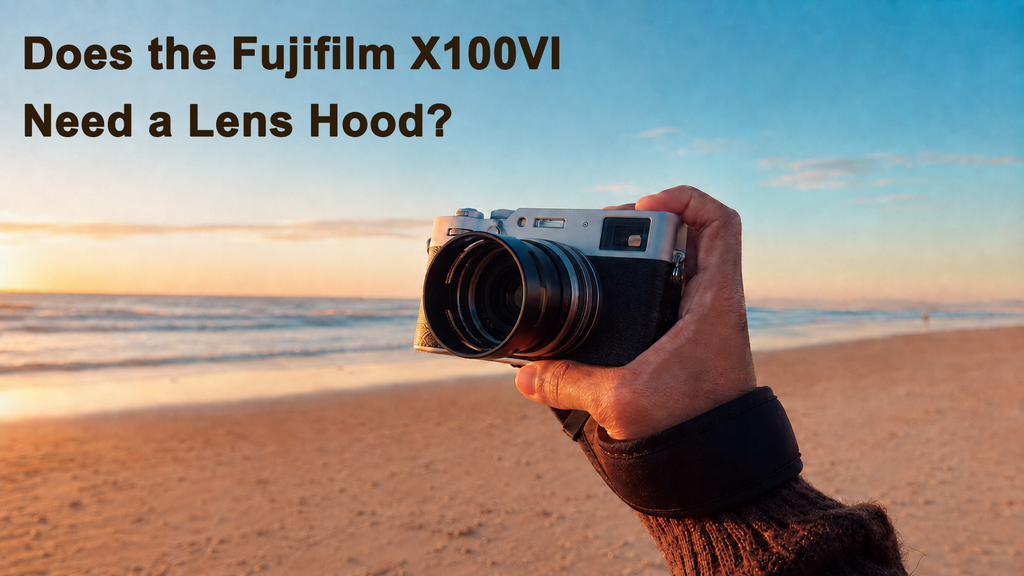
The Fujifilm X100VI is made to be carried. Its compact body and fixed 23mm F2 lens suit street photography, travel, family outings, and everyday moments. Many owners keep it on a wrist strap or shoulder strap instead of leaving it inside a padded camera bag.
That convenience also leaves the front of the lens close to fingers, bag contents, door frames, tables, and changing light. In bright streets, a strong light source just outside the frame can lower contrast or create flare. During travel, the exposed lens may also be more likely to receive a fingerprint or a minor bump.
So, does the X100VI need a lens hood? Not for every photo, but a well-fitted hood is a useful everyday addition for photographers who carry the camera frequently. It can help control stray light, create a buffer around the fixed lens, and work with an adapter ring to support standard 49mm filters.
What Does a Lens Hood Do on the X100VI?
A lens hood extends beyond the front of the lens and shades it from light entering at an angle. For example, the sun may be just above a building rather than inside the frame, or a bright store sign may sit beside the subject at night. That off-axis light can reflect inside the lens and produce flare, haze, or reduced contrast.
A hood can be especially helpful when shooting:
In bright sunlight
During sunrise or sunset
Near windows or reflective buildings
Under streetlights and signs at night
In side-lit or backlit scenes
A hood cannot block a light source that is already inside the composition. It also will not make every photograph sharper. Its purpose is more specific: reduce unnecessary light reaching the front element from outside the intended frame.
Benefit 1: Better Control of Flare and Glare
Lens flare can appear as colored circles, streaks, haze, or a general loss of contrast. Sometimes photographers use flare creatively, but it can also hide detail and weaken colors.
Imagine photographing a person beside a sunlit window. The subject may be correctly exposed, but light striking the lens from the side can make dark areas look gray and reduce color separation. A hood cannot change the exposure, but it may stop some of that side light from reaching the lens.
The same principle applies when moving between sun and shade on a city street, photographing a bright coastline, or working near glass buildings. In these situations, the hood helps preserve the contrast the lens is already capable of producing.
The result will depend on the angle and strength of the light. A lens hood is a practical light-control tool, not a guarantee that flare will disappear in every situation.

Benefit 2: Extra Protection for the Fixed Lens
The X100VI has a fixed lens, which makes front-end protection especially relevant. With an interchangeable-lens camera, a damaged lens can be removed and replaced. With the X100VI, the lens is part of the camera, so a front-end repair is more involved.
When a metal hood is installed, its outer edge sits ahead of the front element. If the camera lightly brushes a jacket zipper, bag divider, table edge, or door frame, the hood may take the first contact instead of the lens area.
This added barrier can help reduce direct contact with:
Fingers and fingerprints
Camera bag contents
Table edges and door frames
Branches, straps, and other objects
Light dust and accidental splashes
A hood does not make the camera impact-proof, and it should not replace a lens cap or careful handling. It simply gives the front of the lens more space from whatever is around it.
How Do a Lens Hood and a 49mm Filter Work Together?
A lens hood and a filter both sit in front of the lens, but they solve different problems.
The hood surrounds the lens without placing glass in the optical path. It blocks some off-angle light and creates a physical buffer around the front element. A filter sits directly in front of the lens. Depending on the type, it can protect the glass, reduce reflections, control exposure, or change the character of highlights.
This means a hood and filter are not competing accessories. In a compatible X100VI setup, they can work together in this order:

Camera lens → adapter ring → optional 49mm filter → lens hood
The filter deals with what passes through the front of the lens, while the hood helps control light arriving from the sides. Used together, they provide more complete light control and everyday protection than either accessory alone.
What Can a 49mm Filter Add?
Once a 49mm filter interface is available, the best filter depends on what and where you photograph.
Protective or UV Filter
A clear protective or UV filter places a replaceable glass surface in front of the camera lens. It can help keep fingerprints, dust, and light scratches away from the front element. For modern digital photography, many users choose one mainly for physical protection.
CPL Filter
A circular polarizing filter can reduce reflections from water, glass, painted surfaces, and foliage. It can also make skies and colors appear richer in certain lighting conditions. It is useful for travel, landscape, automotive, and storefront photography.
ND Filter
A neutral-density filter reduces the amount of light entering the lens. It can help photographers use slower shutter speeds or wider apertures in bright conditions. Although the X100VI includes a built-in ND filter, an external filter can provide additional strength or flexibility.
Diffusion or Black Mist Filter
A diffusion filter softens bright highlights and creates a gentle glow around lights. Many X100VI users choose this type of filter for nighttime street scenes, portraits, and a softer film-inspired look.
The X100VI Filter-Mounting Problem
The benefits of a filter are clear, but the X100VI creates one practical obstacle: a standard 49mm filter cannot be attached directly to the camera as it comes out of the box.
The ring visible around the lens is a decorative ring, not a standard filter mount. It must be removed to expose the camera's accessory threads. A compatible adapter ring is then required to create the correct spacing for the moving lens and provide a usable 49mm filter thread.
This leaves X100VI owners with several decisions. Should they buy the official adapter and hood separately from a filter? Choose a square hood with a stronger vintage look? Use only an adapter and give up the extra shading and bumper protection? The final setup can quickly become more expensive or complicated than expected.
Comparing Popular X100VI Lens Hood Systems
Several well-known brands solve the mounting problem in different ways. None is best for every photographer, so the right choice depends on style, compatibility, included parts, and budget.

Prices and package contents can change, so it is always worth checking the current listing. More importantly, compare the parts included rather than the hood alone. A lower hood price is less useful if an adapter ring still has to be purchased separately.
How the Foto&Tech LH-100 Simplifies the Choice
The comparison reveals the real difficulty. X100VI owners often have to choose between the confidence of an official accessory, the bold styling of a premium square hood, or a basic adapter that provides filter access but no hood protection.
The Foto&Tech LH-100 offers a simpler way through that tradeoff. The set includes both pieces needed for the core setup: a round metal lens hood and a 49mm filter adapter ring. The adapter solves the camera's filter-mounting problem, while the hood helps control side light and provides a buffer around the fixed lens.
Because it uses a standard 49mm interface, the photographer remains free to choose the filter. A protective filter can be added for daily carry, a CPL for reflections, an external ND for more exposure control, or a diffusion filter for softer highlights. The filter is not included, so users are not paying for a fixed filter type they may not want.
The LH-100 weighs about 1 oz, comes in black or silver, and is designed specifically for the Fujifilm X100V and X100VI. At a current listed price of $12.99, it provides the essential hood-and-adapter combination at a much lower entry cost than many premium square systems.
That is why we recommend it for photographers who value function over ornament: it keeps the camera compact, unlocks 49mm filters, adds metal front-lens protection, and avoids turning a simple accessory upgrade into a costly collection of separate parts.
How to Install a Lens Hood and 49mm Filter
With a two-piece set such as the LH-100, installation only takes a few steps:

Always start the threads gently. If the adapter does not turn smoothly, remove it and realign it rather than forcing it.
When Should You Remove the Lens Hood?
There are a few situations where using the camera without the hood may be more convenient:
When the hood creates a shadow while using the built-in flash
When you intentionally want lens flare in the image
When you need quick access to rotate a CPL filter
When using a conversion lens or another large front accessory
When the camera must fit into a very tight case
If you stack more than one filter, check that the lens has enough clearance and that the setup does not produce dark corners.
Is a Lens Hood Worth Adding to the X100VI?
For photographers who frequently carry the X100VI outdoors, a lens hood is a practical addition. It can help manage stray light, give the fixed lens extra space from minor bumps, and make the camera feel better prepared for everyday use.
It becomes even more useful when paired with a 49mm adapter ring. The adapter opens the door to protective, polarizing, neutral-density, and diffusion filters, giving one compact camera more flexibility in different shooting conditions.
If those are the priorities you have for your camera, the Foto&Tech LH-100 Metal Lens Hood and 49mm Filter Adapter Ring offers a simple way to add them. Designed for the Fujifilm X100V and X100VI and available in black or silver, it brings light control, front-lens protection, and 49mm filter access together without turning the camera into a bulky setup.